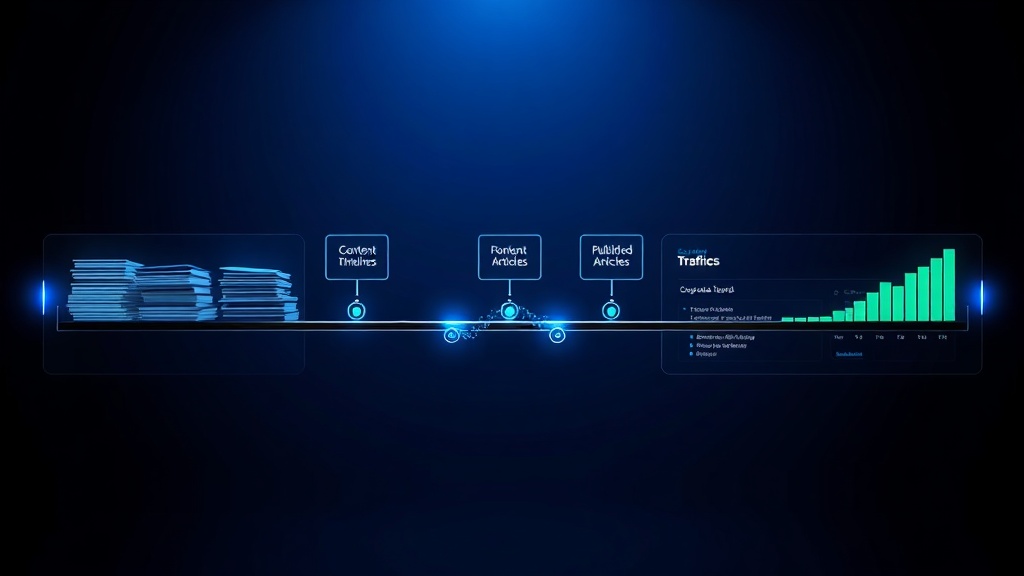
An end to end content automation pipeline connects keyword research, drafting, review, and publishing into a single workflow that runs with minimal manual intervention. For teams publishing consistently, this can cut production time by 60-70% while maintaining quality — provided editorial review remains a human step.
The pipeline works best when each stage has clear handoff criteria: keywords must pass a relevance threshold before moving to drafting, drafts must meet a quality score before review, and reviewed articles must pass a final check before auto publishing.
No pipeline eliminates the need for human judgment — it automates the repetitive parts so your team focuses on strategy, editing, and optimisation.
- Automate keyword research and clustering to surface high-opportunity topics faster
- Use AI drafting for first drafts, but always route through human editorial review
- Auto publishing works when content quality is consistent — premature automation amplifies quality problems
- Measure pipeline success by time saved per article and content performance, not just volume
What Actually Matters in Content Automation
Most teams start automating content without a clear pipeline, ending up with a patchwork of tools that create more overhead than they save. The real cost isn't the tool subscription — it's the hours spent stitching together exports, reformatting drafts, and manually publishing each article.
For example, a SaaS team publishing eight articles per month might spend 12 hours per week just moving content between a keyword tool, a writing tool, and a CMS. That's time they could spend on editorial review and content strategy.
The common mistake is automating the wrong parts first. Teams often jump to AI drafting before fixing their keyword research process, or they enable auto publishing before establishing a consistent editorial review workflow. This creates a pipeline that produces low-quality content faster.
Over time, the compounding consequence is a content library full of articles that rank poorly and need rewriting — costing more in the long run than if they'd built the pipeline correctly from the start.
If keeping a consistent publishing schedule feels impossible without a dedicated team, Zorenax automates the entire cycle — keyword to published post, on schedule, without manual work. Start building your end to end content automation pipeline today and see how Zorenax Auto Publishing eliminates manual CMS work.
Ready to automate your content pipeline?
Stop juggling tools and manual exports. Zorenax connects keyword research, AI drafting, and publishing into one seamless workflow.
No credit card required. See Zorenax pricing for plans starting at $49/month.
How Content Teams Actually Approach Pipeline Automation
The common assumption is that an end to end pipeline means fully hands-off — keywords in, published articles out. In practice, the most effective pipelines are semi-automated, with clear human checkpoints at the editorial review and final quality gate stages.
What most teams miss is that the pipeline's bottleneck isn't drafting speed — it's editorial capacity. Automating research and drafting without increasing editorial bandwidth just shifts the bottleneck. The pipeline only delivers value when every stage is balanced.
The teams that succeed treat the pipeline as a workflow orchestration problem, not a content generation problem. They define explicit criteria for moving content between stages and measure throughput at each stage, not just output.
- Automating keyword research without a relevance filter surfaces too many low-opportunity topics — you need a scoring system to prioritise
- AI drafts save time, but they require a consistent brief format to produce usable output — invest in brief templates first
- Auto publishing without a quality check creates a feedback loop where poor content gets indexed and drags down site authority
- The pipeline's value is proportional to editorial throughput — if editors can't keep up, automation creates a backlog, not efficiency
Practical Content Automation Workflow
For example, a B2B SaaS startup with one content manager and two freelance writers can build a pipeline that produces four articles per week without burning out the team. The key is to automate the parts that don't require human judgment and create clear handoff criteria between stages.
One limitation to watch for: if your keyword research stage produces topics that don't align with your content strategy, the entire pipeline generates irrelevant drafts. Set a weekly review of keyword clusters to ensure strategic alignment before they enter the drafting queue.
As the team grows to five or more articles per week, the pipeline scales by adding parallel review lanes — multiple editors can pull from the same review queue. The automation stages (research, drafting, publishing) handle increased volume without additional effort.
- Keyword research and clustering: Use a tool to surface topic clusters based on search volume and relevance. Score each cluster against your content pillars and only move high-scoring clusters to the next stage. This prevents the pipeline from generating content that doesn't serve your strategy.
- Brief generation: For each approved cluster, generate a content brief that includes target keywords, outline, competitor analysis, and internal linking suggestions. A structured brief ensures AI drafts are on-topic and reduces editorial rework.
- AI drafting: Feed the brief into an AI writing tool to generate a first draft. Set a minimum quality threshold (e.g., readability score, keyword density, section completeness) — drafts that don't meet the threshold are flagged for regeneration rather than sent to review.
- Editorial review: Human editor reviews the draft for factual accuracy, brand voice, and structural flow. This is the only non-automated stage — it's where quality is ensured. The editor can approve, request revisions, or reject the draft.
- Auto publishing: Once approved, the article is automatically published to your CMS with featured image, meta description, and internal links. Auto publishing works best when you have a consistent review process — without it, you risk publishing low-quality content at scale.
The automation flow described above is what the Zorenax auto-publishing system runs for you — set your cadence once, and content goes live without intervention.
Trade-Offs: Manual vs Automated Pipeline
A fully manual workflow gives you complete control over every detail but doesn't scale beyond a few articles per month. An automated pipeline sacrifices some control for speed and consistency. The right choice depends on your publishing volume and editorial resources.
Teams publishing fewer than four articles per month may not need automation — the setup overhead outweighs the time savings. Teams publishing eight or more articles per month benefit significantly from automation, especially if they have limited editorial staff.
| Task | Manual | With Zorenax |
|---|---|---|
| Keyword research | Manual search and export | Automated clustering |
| Drafting | Writer creates from scratch | AI generates from brief |
| Editorial review | Full human review | Human review (unchanged) |
| Image creation | Designer or stock photos | Auto-generated featured image |
| Publishing | Copy-paste to CMS | One-click auto publish |
| Time per article | 8-12 hours | 2-4 hours |
Implementation Checklist: End to End Content Automation
Today: Audit your last 10 published articles against four criteria — time from topic selection to publish, number of tools used, editorial review hours, and post-publish performance. This baseline tells you where the pipeline will have the biggest impact.
This Week: Set up a keyword research and clustering workflow in Zorenax. Use the Keyword Opportunities feature to generate topic clusters, then configure the AI Blog Generation to produce drafts from those clusters. Zorenax handles the full pipeline from keyword to published article, including featured images and auto publishing to WordPress.
Next 30 Days: Run 12 articles through the pipeline and measure time saved per article, editorial review hours, and content performance. A successful pipeline should cut production time by at least 50% while maintaining or improving search rankings.
Next Steps After Your Pipeline Is Live
You now know that an end to end content automation pipeline isn't about removing humans — it's about removing repetitive work so your team can focus on strategy and quality. The practical implication is that you can publish more consistently without burning out your content team.
If automating this workflow without sacrificing quality sounds right, Zorenax handles the full pipeline — keyword research to published article — and you can start with 12 free credits to see how it fits your process. The pipeline includes keyword clustering, AI drafting, featured image generation, and auto publishing to WordPress.
The first step is to audit your current workflow and identify the biggest time sink — that's where automation will deliver the most value.
Frequently Asked Questions
How do I prevent AI-generated content from sounding generic in my pipeline?
The key is a detailed content brief that includes brand voice guidelines, target audience, and specific angles. Without a structured brief, AI drafts tend to be generic. Provide examples of your brand's tone and include them in the brief template. Also, set a rule that every draft must be edited by a human before publishing — AI handles the structure, humans add the personality. For example, a SaaS company might include their product's unique value proposition and competitor differentiators in the brief to ensure the draft is on-brand.
What's the minimum team size needed to run an end to end content automation pipeline?
A single content manager can run the pipeline if they handle editorial review themselves. The automation handles research, drafting, and publishing — the human only needs to review and approve. For teams of one, limit output to 4-6 articles per week to keep review quality high. Larger teams can add parallel reviewers to scale volume. The pipeline doesn't require dedicated technical staff; most tools have no-code interfaces.
Will auto publishing hurt my SEO if I publish multiple articles per day?
Auto publishing itself doesn't hurt SEO — publishing low-quality content does. If your pipeline includes a quality gate (human review) and you only publish articles that meet your standards, frequency is fine. Google's guidance is about quality, not volume. However, if you auto publish without review and push out thin content, you risk penalties. Start with a conservative cadence (e.g., 1-2 articles per day) and increase as you validate quality.
How do I handle internal linking in an automated pipeline?
Include internal linking rules in your content brief. For example, specify that each article must link to at least two existing pillar pages and one recent article. Some automation tools can suggest links based on keyword matching, but manual review is still recommended to ensure relevance. A practical approach is to have the editor add internal links during review — it takes 5 minutes per article and ensures links are contextual.
What happens if the pipeline produces a draft that's completely off-topic?
Set a quality threshold before the draft reaches the editor. For example, require a minimum readability score (e.g., Flesch-Kincaid 60+), keyword density within a range, and section completion. Drafts that fail these checks are automatically flagged for regeneration with a revised brief. This prevents low-quality drafts from wasting editorial time. In practice, this catches about 80% of off-topic drafts before human review.
Can I use the same pipeline for different content types like listicles, how-tos, and case studies?
Yes, but you need separate brief templates for each content type. A listicle brief should specify the number of items and format, while a case study brief needs sections for problem, solution, and results. The pipeline stages remain the same — only the brief template changes. Create a library of 3-5 templates and select the appropriate one when adding a topic to the pipeline. This ensures the AI generates the right structure for each content type.
Your content calendar should run itself.
Stop spending hours on manual publishing. Zorenax's end to end content automation pipeline handles everything from keyword research to auto publishing.
Publish your first automated article today. See Zorenax pricing to find the right plan for your team.